Guide
How Long Should Ground Beef Be Cooked? Times by Method
Ad links. We may earn a commission on purchases, at no extra cost to you.
Ground beef is cooked when every part of it has reached 160 °F (71 °C) — that is the real answer, and the clock only estimates how long that takes. Loose ground beef broken up in a hot skillet usually gets there in roughly 7 to 10 minutes per pound (450 g). In a slow cooker, browned ground beef is safe long before the dish is finished, so the schedule you follow — commonly 6 to 8 hours on low or 3 to 4 hours on high — belongs to the chili, sauce or casserole around the beef rather than to the beef itself. In a pressure cooker, the beef is done within a few minutes on the sauté setting, and the pressure time is again dictated by the beans, grains or vegetables sharing the pot. Everything below is our editorial reading of how those numbers shift in a normal kitchen; we have run no tests of our own and report no measurements.
Temperature decides, time only estimates
A whole steak can be served rare because bacteria live on its surface, and searing the surface handles them. Grinding changes that logic completely: it takes whatever was on the outside of the cuts and distributes it through the entire batch. That is why ground beef has a single doneness target — 160 °F (71 °C) throughout — and why a recipe's stated minutes are a starting point rather than a rule.
Loose crumbles cool fast, so read the temperature while the beef is still in the pan rather than counting on residual heat to finish the job. Gather the crumbles into a mound and slide the probe in from the side so the tip sits inside the meat rather than touching the pan. Check two or three spots; a skillet with hot and cool zones will happily leave one corner behind.
- Target: 160 °F (71 °C) in the coolest part of the meat.
- Probe a mound of crumbles from the side, not the top.
- Check several spots — pans heat unevenly.
- If the beef is being held before serving, keep it above 140 °F (60 °C).
In a skillet: about 7 to 10 minutes per pound
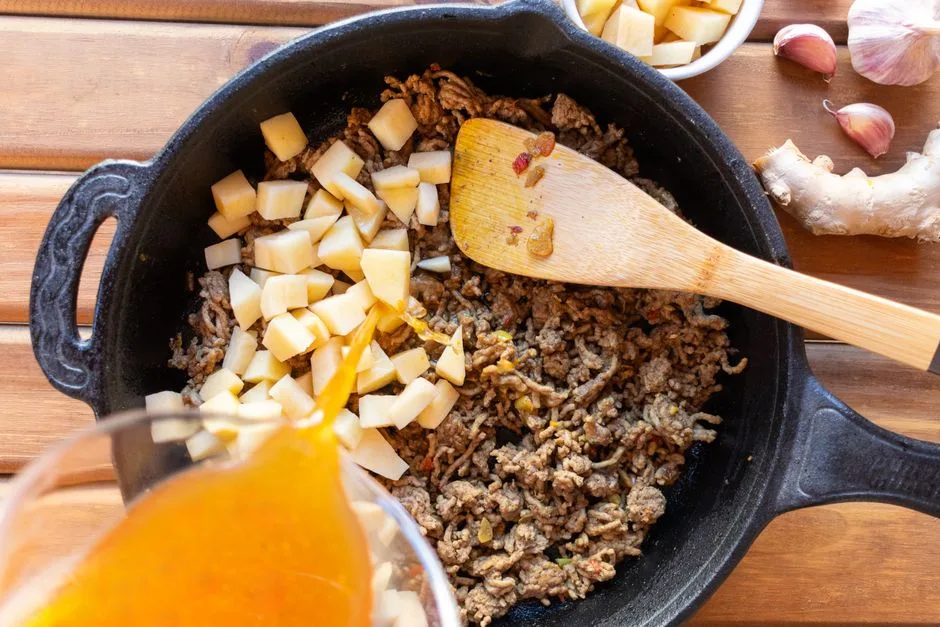
Over medium-high heat, a pound of ground beef added to a preheated pan and broken up as it cooks is typically done in 7 to 10 minutes. Leaving it undisturbed for the first two or three minutes gives you browned surfaces worth having; after that, break it apart every minute or so until no large clumps remain.
The number moves for predictable reasons. Beef straight from the refrigerator starts colder and takes longer. A crowded pan is the biggest culprit: too much meat releases moisture faster than it can evaporate, the beef simmers in its own liquid instead of browning, and the time stretches well past ten minutes with a worse result. Doubling the quantity in the same skillet more than doubles the time — brown in two batches instead. Thin, lightweight pans lose heat when the cold meat lands and recover slowly. Adding onions or peppers at the same time as the beef adds water to the pan and does the same thing.
Drain rendered fat once the beef is browned rather than partway through, and salt toward the end — salt pulls moisture to the surface, which works against browning if it goes in at the start.
- Preheat the pan before the beef goes in.
- One pound per large skillet; brown larger amounts in batches.
- Leave it alone for the first couple of minutes, then break it up.
- Pooling liquid means the beef is steaming — raise the heat or split the batch.
In a slow cooker: brown first, then follow the dish
A slow cooker cannot brown anything. It holds a gentle, moist heat, which is excellent for breaking down a chuck roast and does nothing for the flavor that comes from a hot dry surface. Browning ground beef in a skillet first, then scraping meat and the browned bits into the crock, is the single change that most improves a slow-cooked chili or meat sauce.
Raw ground beef added straight to the cooker will eventually reach a safe temperature, but it tends to set into one grey mass, and a full, cold crock on the low setting spends a long stretch climbing through the 40–140 °F (4–60 °C) range where bacteria multiply fastest. If you do add it raw, break it up thoroughly, keep the pot no more than three-quarters full, and run the first hour on high before switching down.
Once browned beef is stirred into liquid, it is already past the doneness target. From that point the timing is the recipe's, not the meat's: a chili holds 6 to 8 hours on low or 3 to 4 on high because the beans, aromatics and sauce need it, not because the beef does.
- Brown in a skillet, then deglaze the pan into the crock so the flavor follows.
- Keep the cooker between about half and three-quarters full for predictable timing.
- Raw beef going in: break it up well and start on high.
- Lifting the lid to peek adds meaningful time — the pot has to climb back.
In a pressure cooker: minutes on sauté, then it's the other ingredients' clock
Use the sauté function exactly as you would a skillet, with one adjustment: the pot is narrow and deep, so it crowds easily. Half a pound to a pound at a time browns; two pounds at once steams. Once the beef is browned, it is done, and the minutes you set at high pressure exist for the dried beans, rice, potatoes or tough cuts that come next.
Before locking the lid, deglaze thoroughly with stock, water or a splash of wine and scrape the bottom clean. Browned residue left stuck to the base is the usual cause of a scorch warning midway through a run. Remember also that release method is part of the total time — a natural release adds a stretch of quiet cooking after the timer ends, while a quick release stops it abruptly and can sputter with a starchy, meaty pot.
Frozen ground beef is the awkward case. A solid block will not break apart on sauté, so it goes in whole with a little liquid, comes up to pressure, and is broken up once it has loosened; expect noticeably longer than the thawed equivalent, and confirm with a thermometer rather than a stated time, since block thickness varies far more than weight suggests.
- Brown in batches — a deep, narrow pot crowds faster than a skillet.
- Deglaze and scrape the base before sealing to avoid a scorch warning.
- Pressure minutes belong to the beans and grains, not to the beef.
- Natural release is extra cooking time; factor it into the total.
Why "no more pink" is not a doneness test
Color is the most common way people judge ground beef and one of the least reliable. Meat can lose its pink and look convincingly done well below the safe temperature, which is especially common with beef that has been frozen and thawed. It can also stay pink above the target when the pH runs high or when other ingredients in the mix contribute nitrites — cured meat, certain vegetables, or a smoky seasoning blend.
Both errors happen in ordinary kitchens, and only one of them is dangerous. An instant-read thermometer settles it in a few seconds and costs nothing to use. Our editorial position is straightforward: judge by temperature, and treat color as a cue for when to start checking rather than as the verdict.
- Grey does not guarantee 160 °F (71 °C).
- Pink does not prove the beef is underdone.
- Previously frozen beef browns misleadingly early.
- An instant-read thermometer removes the guesswork.
How long is too long: what happens after the safe point
Past 160 °F, the proteins keep contracting and squeezing out moisture. Very lean beef — the 93/7 and 90/10 grades — has little fat to compensate and turns dry and slightly gritty quite quickly, particularly when it is browned hard and then held. An 80/20 grind tolerates a long simmer far better, which is why it suits all-day chili and ragù.
A long braise does not tenderize crumbles the way it tenderizes a pot roast. The roast improves because intact connective tissue slowly melts into gelatin; crumbles have already been cut apart, so extended time mostly benefits the sauce around them rather than the meat itself. Sitting in liquid keeps them from drying out, but it will not undo a lean grind that was overcooked in the pan.
The practical consequence: if you are working with very lean beef in a long-cooking dish, brown it lightly and add it later in the cooking rather than at the start, and let the fattier grind take the all-day slot.
- 80/20 suits long slow-cooker and pressure-cooker dishes.
- Lean grinds dry out fast once past the safe point.
- Extra hours improve the sauce, not the texture of the crumbles.
- Add very lean beef later in a long cook.
Burgers, meatballs and meatloaf: same target, different clock
Shaped ground beef takes the same 160 °F (71 °C) target, but the time follows thickness rather than weight. A standard patty is a matter of a few minutes per side over solid heat; meatballs in a moderate oven take a good deal longer; a full loaf can run well past an hour. None of those numbers is worth memorizing, because a thick loaf and a thin one behave nothing alike. Probe the geometric center — the last place to heat.
For meatballs finished in a slow cooker, brown or bake them first. They then go into the sauce already safe and simply absorb flavor. Raw meatballs dropped into a cold crock sit in the danger zone far too long while the pot climbs, and they tend to fall apart before they firm up.
- Thickness sets the time; weight does not.
- Probe the center of a loaf or ball, angling in from the side.
- Brown or bake meatballs before they go into a slow cooker.
- Rest a loaf briefly before slicing so it holds together.
Frequently Asked Questions
Can I put raw ground beef straight into a slow cooker?
It will reach a safe temperature, but it is not the better route. Raw beef clumps into one grey mass, and a full cold crock on low spends a long time climbing through the range where bacteria multiply fastest. If you go that way, break the meat up thoroughly, keep the pot no more than three-quarters full, and start on high for the first hour. Browning in a skillet first gives markedly better flavor and texture.
How long does frozen ground beef take?
Longer, and by an amount that depends on how thick the block is rather than what it weighs. In a skillet, add a little liquid, cover, and scrape off the thawed outer layer as it loosens, working inward; it can easily take twice as long as thawed beef. In a pressure cooker, bring the block up to pressure with liquid, then break it apart once it gives. In both cases confirm 160 °F (71 °C) with a thermometer rather than trusting a stated time.
Is a little pink in the middle acceptable?
Not as a judgment call based on looks. Ground beef should reach 160 °F (71 °C) throughout because grinding mixes surface bacteria through the whole batch. Confusingly, beef that has hit that temperature can still show pink when the pH is high or when other ingredients contribute nitrites — so pink alone does not mean undercooked either. The thermometer is the only reading that answers the question.
Can ground beef be overcooked in chili or a meat sauce?
Yes, though the liquid hides it for a while. Once past the safe point, the proteins keep tightening and forcing out moisture, and a lean grind turns dry and grainy even while sitting in sauce. A long simmer deepens the sauce but does not make crumbles more tender the way it does a chuck roast. For an all-day dish, an 80/20 grind is the more forgiving choice.
How do I take the temperature of loose crumbles?
Push the crumbles into a mound at least an inch deep and slide an instant-read probe in horizontally so the tip sits surrounded by meat and well clear of the pan surface. Read two or three different spots, since skillets and slow cookers both have hot and cool zones. Do it while the food is still on the heat — thin crumbles shed heat quickly, so a reading taken after plating tells you less.
Related guides